

No incisions
Everything is done endoscopically.
Signature procedure
Holmium laser enucleation of the prostate
If you struggle to urinate, wake up several times a night or feel your bladder never fully empties, the most common cause is benign prostate enlargement. HoLEP offers a lasting solution, with no incisions.
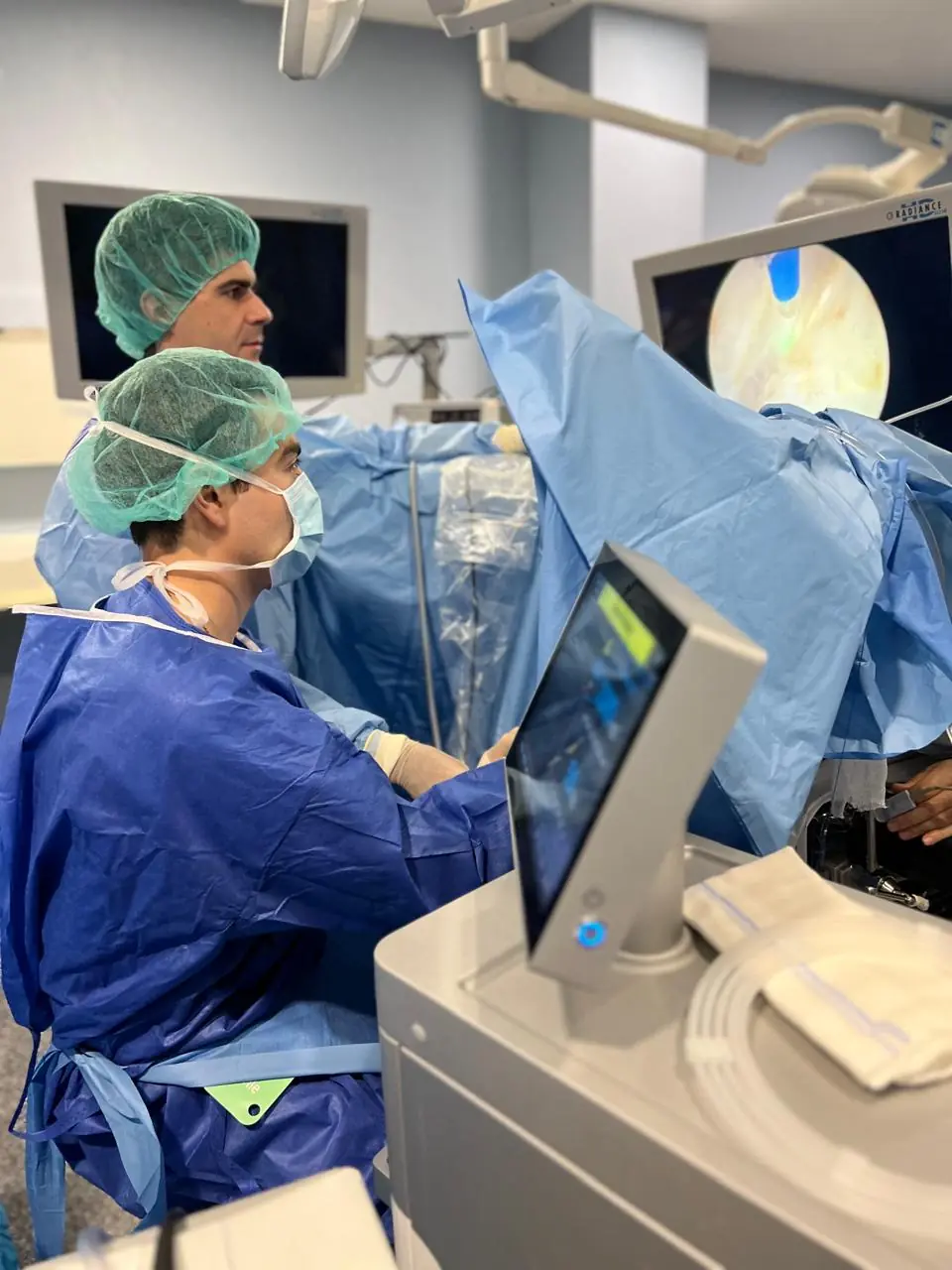
It is an endoscopic procedure performed through the urethra, with no cuts in the skin. Using holmium laser energy, the tissue blocking the flow of urine (the adenoma) is completely separated from the prostate capsule, following its natural anatomical plane.
The freed tissue is moved into the bladder, where it is broken up and removed. All of it is sent to pathology, so it can be analyzed to rule out other conditions.
Everything is done endoscopically.
Works even for very large prostates that used to require open surgery.
The laser seals tissue as it works, reducing the risk of bleeding.
The catheter is usually removed within 24 to 48 hours and the hospital stay is short.
Because all obstructing tissue is removed, the need for repeat surgery is very low.
Complete tissue is obtained for pathology.
Whether HoLEP is right for you is always decided in consultation, after a complete evaluation.
Medical history, examination, PSA, ultrasound and, when needed, uroflowmetry.
Pre-operative tests and anesthesia assessment. We go over expectations and questions together.
Under regional or general anesthesia. Duration depends on the size of the prostate.
Early catheter removal, quick discharge and a gradual return to your activities.
The surgery is done under anesthesia. Afterwards, discomfort is usually mild and controlled with common pain relievers. With no skin incisions, pain is lower than with open surgery.
In most cases, one to two days. It depends on the size of the prostate and your overall health.
TURP removes the prostate in small pieces and has size limits. HoLEP removes the entire obstructing tissue along its anatomical plane, which is associated with less bleeding, less catheter time and fewer repeat procedures, especially in large prostates.
Erectile function is generally preserved. Retrograde ejaculation, however, is common. We will discuss it in detail during your evaluation.
Many policies cover it. We work with several insurers; message us and we will guide you.
Book your visit
Book an evaluation to find out whether HoLEP is an option for you.